
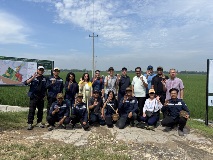
Just outside Beijing, an old mine has been given a new lease of life. Rows of solar panels greet the Philanthropy Asia Alliance (PAA) team as they arrive at Jinyu Zhaikou. In Singapore, solar panels are typically installed atop the skyscrapers that define our horizon, or as floating farms at sea, making the most of scarce land to power homes and businesses. The journey towards a cleaner energy future in China follows a similar instinct for innovation, though the model behind it is distinctly its own.
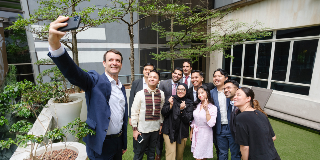
Earlier this year, the PAA team visited examples of public-private collaboration across fields, classrooms, and cultural landmarks to better understand China’s approach to philanthropy and how the highly evolving nation is scaling social and environmental impact.
What comes after coal
At the Zhaikou Mine Ecological Restoration Project, Beijing's first large-scale photovoltaic development, solar panels now rise above exhausted mine pits and subsided coalfields, transforming once-barren land into a source of renewable energy. The electricity generated is expected to meet the annual needs of 5,000 households through the national grid. Generation has already exceeded initial estimates, thanks to mounting systems that follow the terrain's natural slopes and the sun's path.
At the same time, the land beneath the panels and on the hillsides is being restored through the planting of drought-resistant vegetation. The vegetation also prevents further erosion and helps protect the solar panels. Together, these efforts advance China's energy transition while restoring degraded land. They reflect an approach that combines coordinated policy, patient capital and long-term planning.
Agriculture that earns at the till
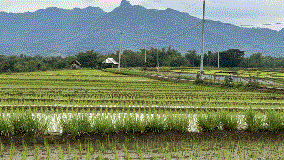
The same systems-level instinct reaches into how food is grown, and the stakes there are regional. Farming accounts for a large share of global emissions, while Asia Pacific holds one of the world's largest agricultural workforces. This gives the region both a significant opportunity and responsibility to reduce emissions and at the same time, profit from doing so. PAA backs this directly through the Decarbonising Rice initiative, developed by Temasek Life Sciences Laboratory, with trials running in India, Indonesia, and Laos. China is answering the same question through a different route at Jinpoluo Village in Miyun District, among the earliest rural settlements near Beijing to organise itself around a zero-carbon target.

What began in 2016 as a grassroots effort under the Beijing Low-Carbon Agriculture Association has matured into a nationally recognised programme drawing support from China's Ministry of Agriculture and Rural Affairs. The village measures its emissions in farming, energy, waste and transport, while organic methods, composting and tree planting return carbon to the soil. The economics are what let the model travel. A verified green label already earns farmers higher prices at market. Once agricultural soils are included in China’s national carbon trading scheme, those same fields could generate a second income through the carbon they store. Sustainable farming succeeds when growers are rewarded for producing food responsibly. Jinpoluo is building the systems to make that possible.
Education that follows the child
Among the many lessons from the visit, China’s efforts to widen access to learning showed how catalytic action works in practice. That principle is reflected in the work of Dami and Xiaomi.
The Shenzhen social enterprise provides early intervention for children with autism, language impairments and learning difficulties. Over a decade, its therapists logged more than 80 million tagged observations of how children respond to treatment, and that record now trains an artificial intelligence platform called RICE AI. The system has cut the time needed to produce an assessment report from three hours to under thirty minutes, freeing specialists for the part of the work only a person can do. Speed is the visible gain. The structural one is that a model developed in cities with specialist expertise can now reach families far from any qualified practitioner, with very little additional cost per child.

That same economy of distance defines Pu Gong Ying Middle School on Beijing's outskirts. The institution was founded for children of low-income migrant families who tend to fall outside the city's better-resourced classrooms. The school integrates physical, intellectual, and emotional development into everyday learning and adapts its teaching to each pupil. Each pupil follows an individual learning pathway while working towards the same opportunities. Through its research centre, opened in 2022, the approach now travels to rural schools elsewhere.
Both cases converge on the broader possibility that learning systems can be carefully redesigned to extend opportunity beyond geography, financial, or institutional barriers.
A partner's lens on heritage

This visit sat outside PAA's core focus areas, but it illustrated how philanthropy can bring innovation and preservation together.
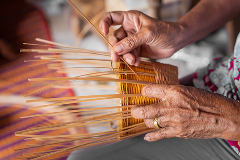
At the Jiankou section of the Great Wall, where the Tencent Foundation and the China Foundation for Cultural Heritage Conservation fund restoration work, digital technology sits at the centre of the restoration effort. Drone surveys and structural data guide trained local crews to stabilise stretches too steep or remote for conventional repair. Other sections were intentionally left untouched to serve as a contrast and reminder. For those unable to make the ascent, a digital record of this UNESCO monument preserves its history and structure and can be accessed as a mini program on one of China’s most widely used apps, WeChat. Catalytic giving has a defined job here, investing in the development and validation of the technology that keeps heritage tangible for the next generation while helping nearby communities manage the weight of tourism the restored wall attracts.
Sharing the lessons learnt
While these examples are only a snapshot, they offer insight into how different parts of China's impact ecosystem are evolving. Across climate, agriculture, education and heritage, they share a focus on designing solutions that can be sustained and expanded over time.
As Chinese philanthropy strengthens ties with partners beyond its borders, there is growing scope for mutual learning. Many of the challenges these initiatives address are shared across Asia and beyond. Different contexts will call for different solutions, but exchanging ideas and experience can help funders and practitioners adapt what works to their own settings.
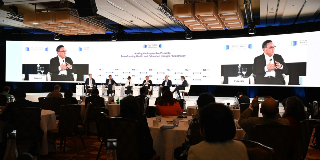
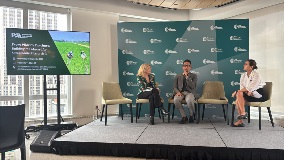
This is the conversation the Tsinghua-PAA Impact Summit in Beijing will open.






.tmb-.gif?Culture=en&sfvrsn=e13997ec_1)
.tmb-.gif?Culture=en&sfvrsn=b5ece239_1)
.tmb-.gif?Culture=en&sfvrsn=6fb3b6df_1)
.tmb-.png?Culture=en&sfvrsn=7fea9931_1)
.tmb-.gif?Culture=en&sfvrsn=3f4b1163_1)
.tmb-.jpg?Culture=en&sfvrsn=fedc60fc_1)